
Reports - Failed Transactions
RELATED ARTICLES
Spark Location: Commerce > Reports > Failed Transactions
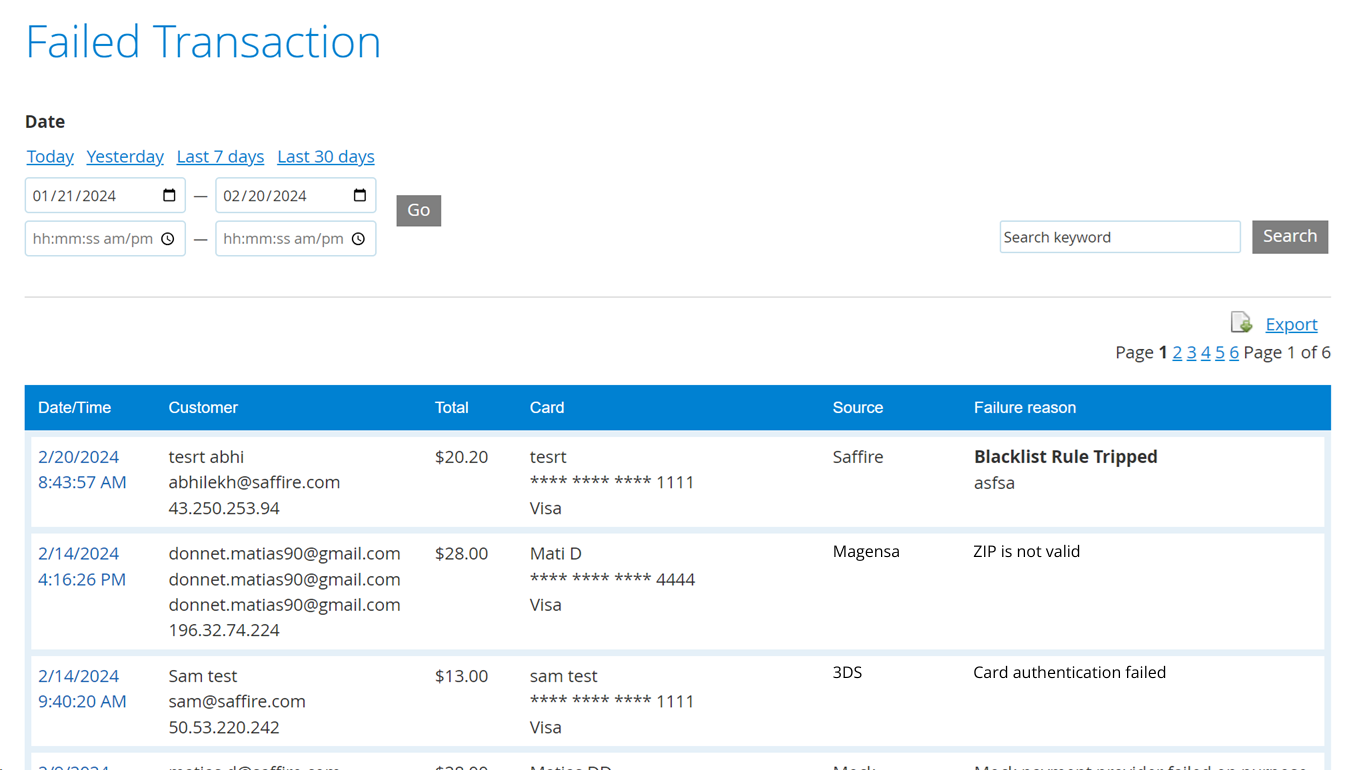
This will be your go-to report when you have a customer reach out for help because they're struggling to complete a sale on your website. This report will capture the Date/Time and Customer information when they are attempting to complete the transaction online. In addition to the customer data, we will also be displaying the Source and the Failure Reason for the transaction.
The sources listed will include:
- Saffire
- Payment Gateway - depending on which Gateway you utilize, the Gateway's name will be displayed
- 3DS* - add-on Fraud Protection service
*Available through select payment gateways. For more information about 3DS, please reach out to us via support@saffire.com and we will happily explain how this service works and discuss pricing.
In addition to informing you where the source of the failure is occurring, we are passing along the reason for the denial. In the case of source=Saffire, we will explain if these are due to any Denylist Rule or Velocity Sales or Transaction Limits that have been set.
If the source of the transaction failure is coming from the Payment Gateway, we will pass along the messaging provided by that Gateway. Sometimes these aren't always clear as to what the resolution is, so if you have questions about why you are experiencing a particular error, please contact Saffire support by clicking the orange button below.
Understanding Failures where Source=Saffire
This information pertains to the rules set up on your Fraud Protection page in Spark.
Per Email/IP Address/Credit Card Gateway Declines Limit Hit
Payment gateway and 3DS declines such as CVV mismatch, incorrect address entered, etc., can count toward a customer's Saffire Velocity Filter decline limits. Once a particular limit is reached, additional attempts from the same customer will be automatically declined, with the specific limit noted as the failure reason.
Decline limits apply across multiple rules. Even if a customer switches to a different email address, the system will continue to evaluate attempted transactions by email address, IP address, and credit card. If the IP address has already reached its decline limit, further attempts from that IP will continue to be declined even if a new email address or credit card is used.
IP address does not match the one used during checkout
Some errors may also occur when the IP address changes during checkout. If the IP address recorded at the start of the session does not match the IP used at the time of payment, the transaction may be blocked for security reasons. This can happen if a customer’s network changes mid-checkout. Advising your customer to refresh their browser and attempt the transaction again may clear up this error.
IP addresses can also be impacted by private browsing modes, particularly when using iCloud private relay on iPhone or iPad devices. Advising your client to exit private browsing mode may allow them to complete their transaction.
Permitting or Preventing Additional Attempts
To allow your customer to try their card again or attempt a different payment method, you can allowlist the customer’s email address or IP address. Allowlisting is available from the Failed Transactions Report by hovering over the timestamp of a failed attempt and selecting Add to Allowlist. Each attempted email address must be allowlisted individually, and you may also choose to allowlist the most recent IP address used.
For comprehensive steps to allowlisting and information on preventing further attempts, visit the Fraud Protection page.
Allowlisting bypasses fraud-limit blocks but does not override declines issued directly by the payment processor, such as those caused by CVV mismatches. If the original decline reason has not been resolved, the cardholder may continue to be declined.
For more information on Saffire fraud prevention settings, visit the Fraud Protection page.
3DS Declines
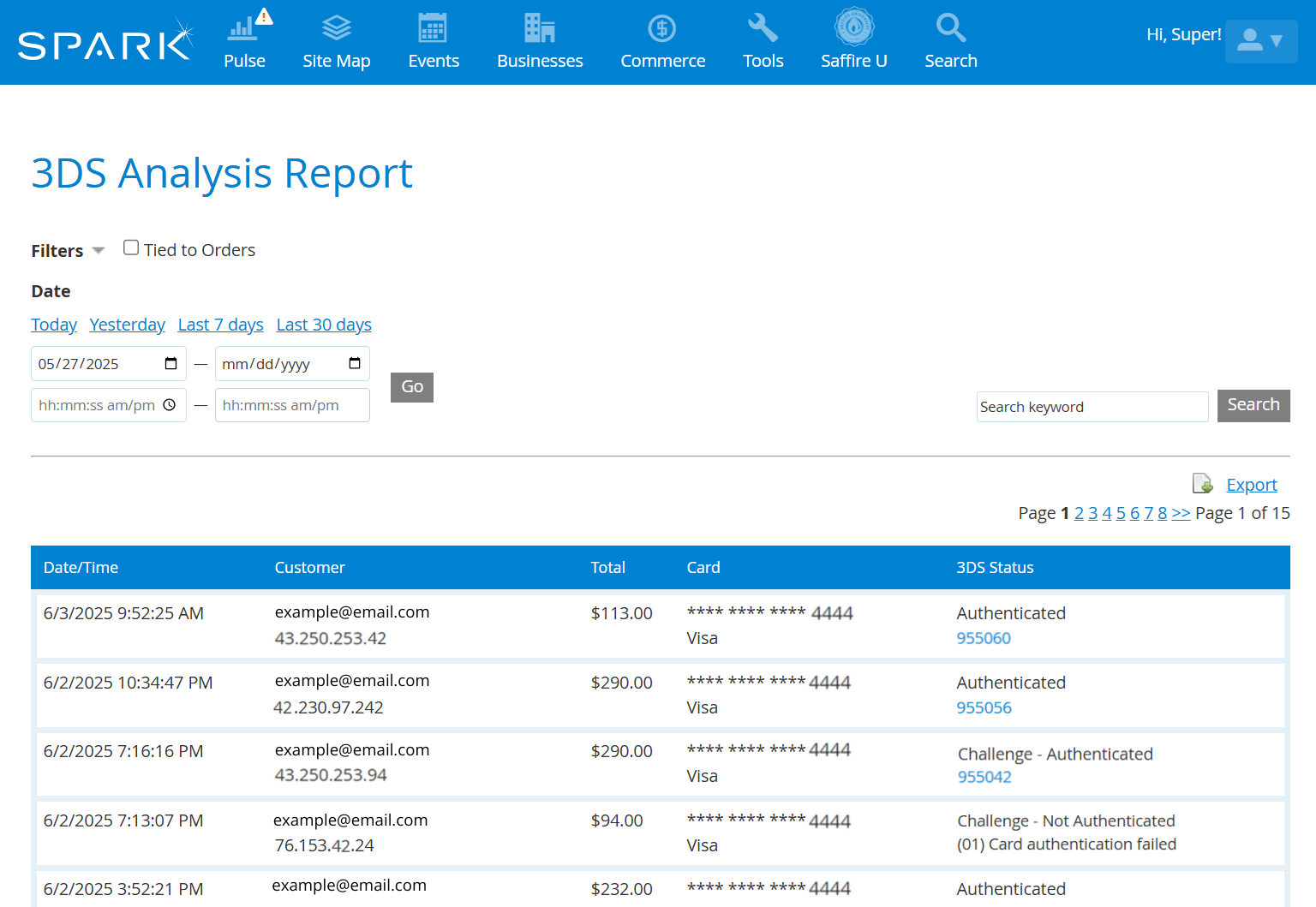
If the source is coming from 3DS, you can find more information under Commerce > Reports > 3DS Analysis.
Troubleshooting Tips
When a customer receives an error message at checkout, there will be an indicator at the bottom of the error message for "Type."
- Type F - Type F errors indicate the transaction was stopped because the system has detected patterns that look like fraud, so the fraud protection tools have been deployed. This either means the Saffire Fraud Protection tools or 3DS tool rules have stopped the transaction. You can check the Failed Transaction Report to see which fraud protection tool blocked the transaction.
- Type G - Type G errors indicate the transaction was stopped at the Payment Gateway. This is often due to insufficient funds, CVV mismatch or address mismatch. It often relates to errors the user made typing in their payment details.
- Type S - Type S errors indicate server level issues. Saffire should be contacted immediately at support@saffire.com for Type S errors.
For ALL error types, we provide as much information as we can for why the transaction was blocked, in the Failed Transaction Report to help you support customers experiencing issues at checkout. You can typically get more information about Type G - Gateway errors by logging into your gateway account's online admin tools, or by contacting your gateway representative.
For more information on common error codes, visit our Knowledgebase article Payment Processor Error Codes.